On Sunday 8 November, the CEO of the most valuable chip company on the planet sent his staff a four-sentence email admitting he had cheated on his wife. Within a day my feed had turned it into a spy thriller, with a Chinese gaming company, a woman named Alice, smuggled superchips, a raid on a data centre and a secret phone call, and more than one confident claim that all of America was now in danger.
My first reaction was that this sounded like a Netflix pitch. My second reaction was that I'd actually seen bits of this in the news over the past two weeks, and I had no idea which parts were real. So I did what any normal person would do at midnight and spent the evening reading everything I could find from the New York Times, Bloomberg, the FT, CNBC, Axios, The Straits Times, Channel News Asia and the actual Federal Register. This post is the whole picture, in order, with a check at the end of which popular claims hold up.
The short version is that the big beats are real and a surprising number of the dramatic details aren't. And the real story is weirder than the gossip, because it is less about romance and more about one very specific number, 4,800, which is the line the US drew to decide which AI chips China is allowed to buy.
"I was unfaithful to my wife. My actions hurt her and our children. There is no excuse for what I did. I am deeply sorry."
the cast
Before the timeline makes sense you need to know who is who, because there are two people called Huang and they are not related.
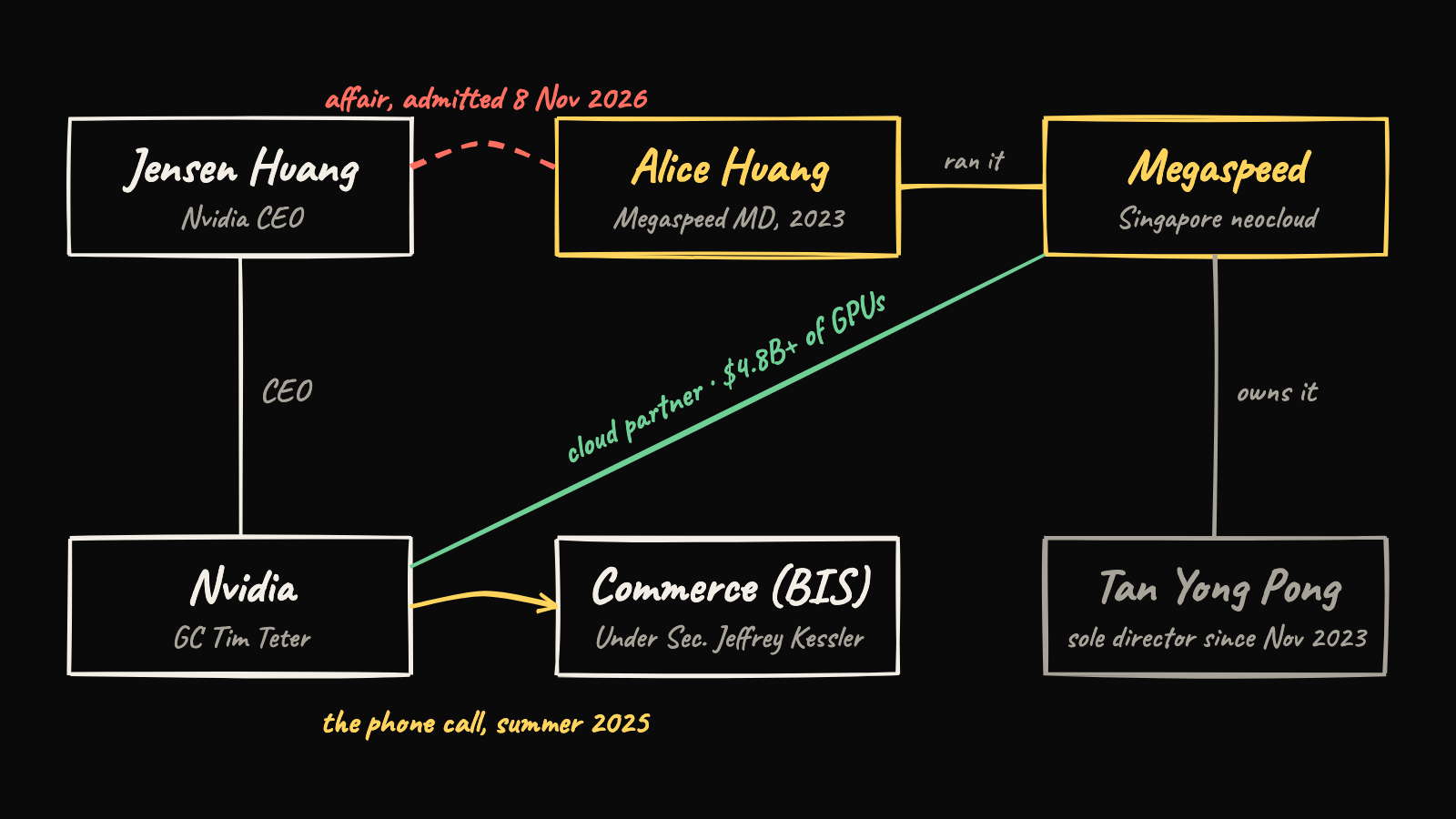
Jensen Huang is Nvidia's co-founder and CEO, 63, married to Lori for about 40 years, and the person whose chips basically run the AI boom. Alice Huang, also reported as Huang Le, is a Chinese national who ran a Singapore company called Megaspeed International in 2023. US intelligence officials, according to the NYT and FT, believe she was cultivated by China's Ministry of State Security to get close to Jensen and nudge him toward arguing for looser chip export rules. That is an allegation from anonymous officials, nobody has charged her with anything, and she hasn't said a word publicly.
Then there are the supporting characters. Megaspeed is a "neocloud", a company that buys Nvidia GPUs and rents the compute out, and it became the biggest Nvidia buyer in Southeast Asia in about three years. Tan Yong Pong is the Singaporean who has owned it since November 2023, and The Straits Times couldn't even confirm where he lives. Tim Teter is Nvidia's general counsel, and Jeffrey Kessler is the Commerce Department official in charge of chip export controls. Hold on to those last two, because they matter a lot later.
how a game studio became a chip whale
Most retellings start in 2008 with a Chinese gaming company, 7Road, "starting to use Nvidia GPUs". The company is real. 7Road was founded in Shenzhen in 2008 and made browser games like DDTank, but I couldn't find a single report connecting it to Nvidia GPUs that year. That looks like the founding date getting merged with something that happened much later.
What actually happened is slower and more boring, which is usually how these things go. A Singapore entity called 7Road International registered in 2015. Around 2016 and 2017, Alice Huang held senior roles at a Shanghai investment firm, usually spelled Hexi in English coverage, which had investment ties to 7Road. In 2019 she reportedly sold a cloud computing business into 7Road. Then in March 2023, 7Road International was renamed Megaspeed, with Alice Huang as managing director and her British Virgin Islands company as the sole owner.
Eight months later, in November 2023, ownership moved to Tan Yong Pong's holding company Swiftdata and Alice Huang resigned. You will see it claimed that Megaspeed became an official Nvidia cloud partner "four days" after that. Megaspeed did become a Nvidia Cloud Partner in 2023, per Bloomberg Law via Axios, but I could not find any primary source for the four-day gap. It shows up only in AI-generated summaries, which is not a sentence I ever wanted to write in a fact-check.
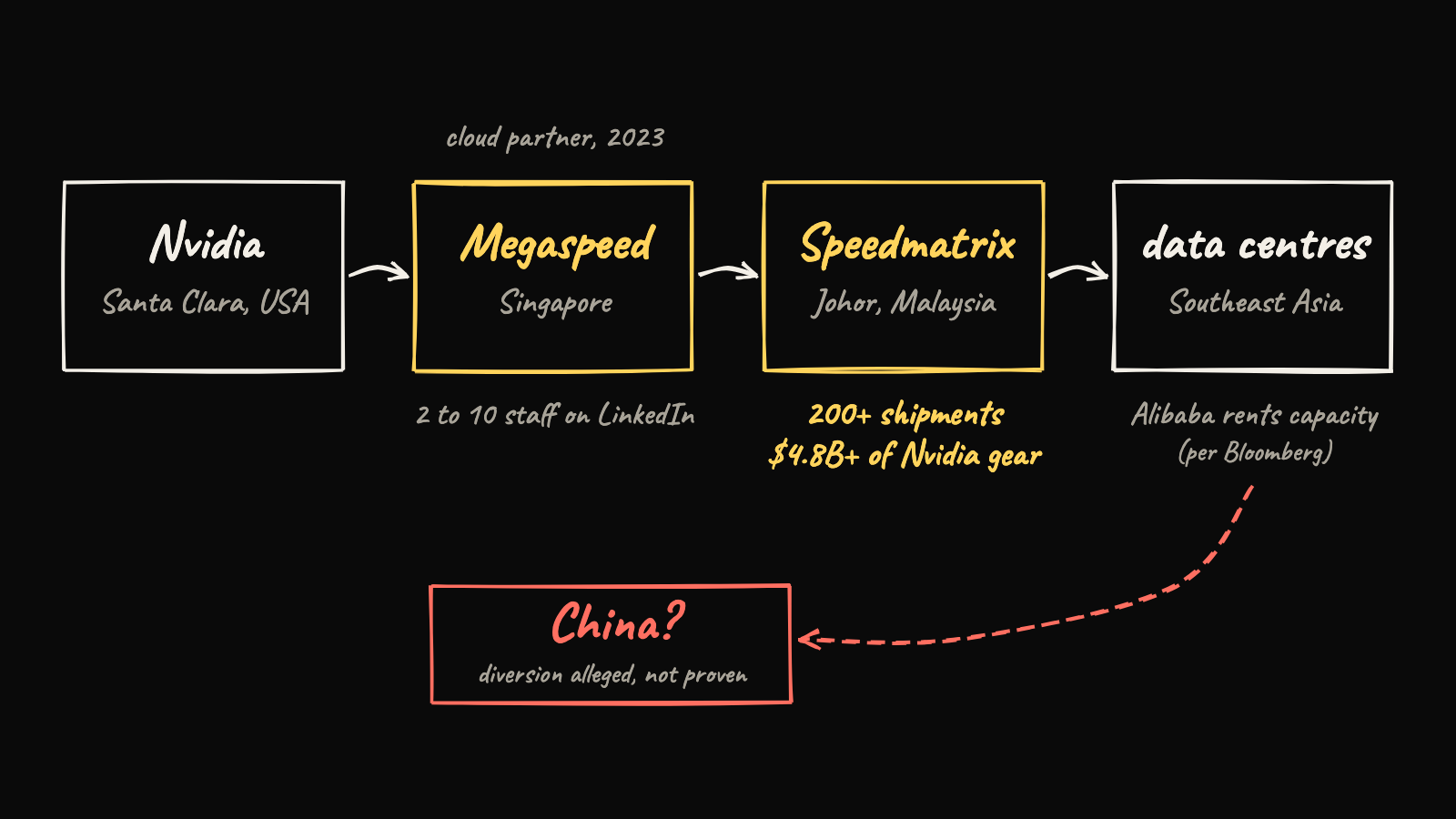
Then the money shows up. In February 2024, Megaspeed set up a Malaysian subsidiary called Speedmatrix in Johor. Starting June 2024 it received more than 200 shipments of export-controlled Nvidia hardware. Reporting in 2025 put that at about $2 billion, and the latest AP figure via Axios is at least $4.8 billion over roughly two years. Megaspeed's own LinkedIn lists 2 to 10 employees.
A short seller, Culper Research, says Megaspeed's balance sheet went from $33 million at the end of 2023 to nearly $3 billion a year later, mostly as refundable deposits from a source it couldn't identify. Culper makes money if Nvidia's stock falls and says so in its own disclosure, so take those numbers with a big pinch of salt. The same report quotes a Megaspeed employee who said something that is hard to forget.
"Alice Huang is actually still our boss."
Megaspeed denies all of this. In December 2025 it said inspections by the US Commerce Department, Malaysia's trade ministry and Nvidia itself had found "no evidence of any violations". In November 2026 it said it was considering suing Bloomberg.
why anyone cares where a GPU goes
This is the part most retellings rush through in a sentence, and it is the part that explains everything else, so I want to slow down.
In October 2022 the US decided that China shouldn't be able to buy the chips you need to train frontier AI models. The rule needed a way to say what "advanced" means, and it landed on two numbers. A chip was controlled if its total processing performance (TPP, roughly how many trillion operations per second it does, multiplied by how many bits each operation uses) was 4,800 or more and its chip-to-chip link was 600 GB/s or faster. Both conditions had to be true.
Nvidia read that "and" very carefully. The A100 had a TPP of about 4,992 and a 600 GB/s link, so it was blocked. So Nvidia made the A800, which was the same chip with the link throttled to 400 GB/s, and then the H800, which was an H100 with the same throttle. Here's the thing that broke my brain a little. The H800 had the full compute of an H100, a TPP of about 15,800, more than three times the A100. The "watered-down" export chip China got in 2023 was in raw compute terms a better chip than the one that was banned in 2022. Only the cable between the chips was slower.
The US noticed. In October 2023 it rewrote the rule, dropped the link test entirely, and drew the line at TPP alone, plus a density test so you couldn't just spread the compute over a bigger die. That caught the A800 and H800 in one go. Nvidia's answer was the H20, which sits at a TPP of 2,368, just under the next line at 2,400. People often call the 2023 rule a "blanket ban", which oversells it, because the point of the rewrite was a lower threshold and the H20 was designed to sit just under it.
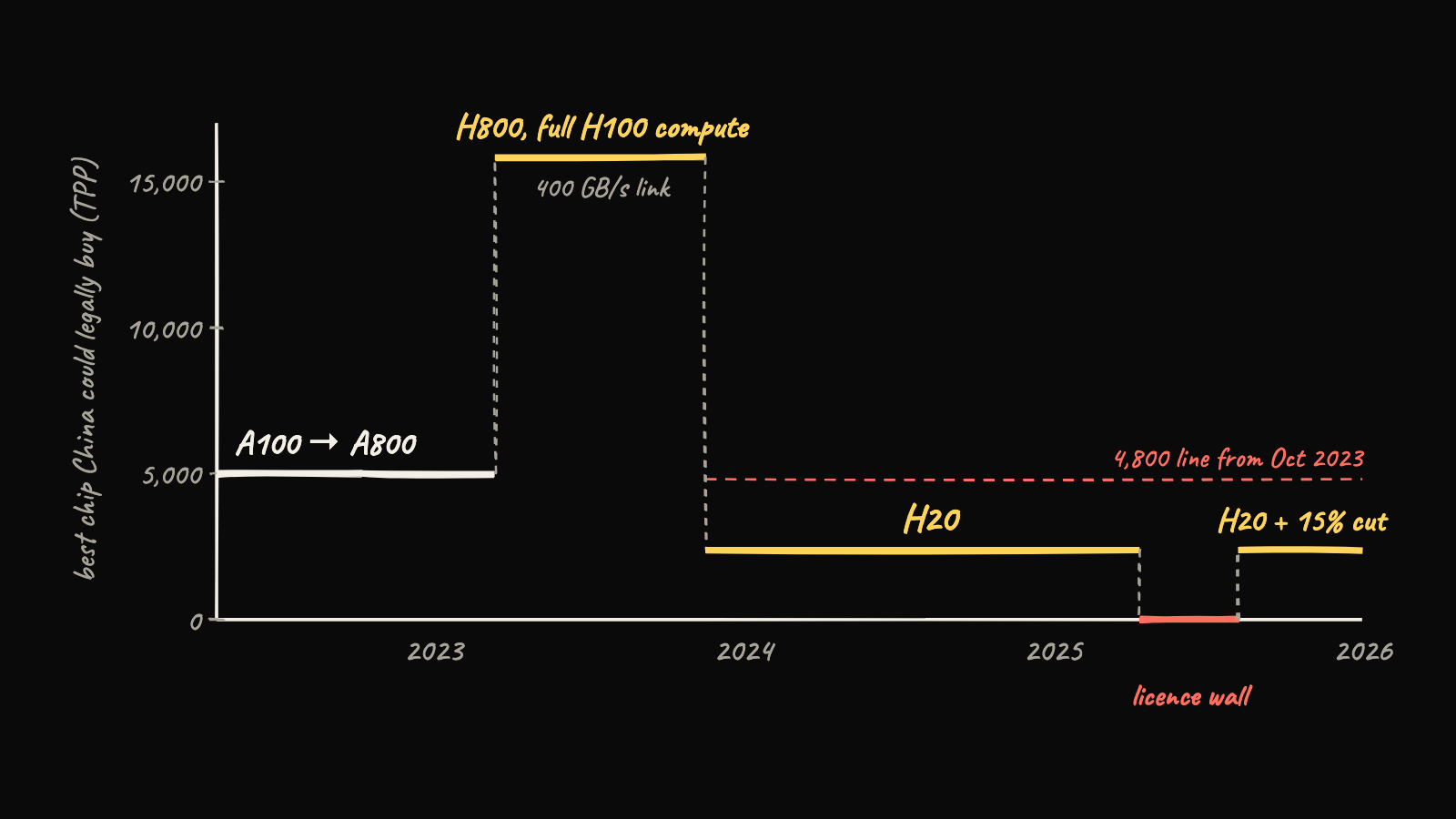
After that the rules stopped being a threshold game and became politics. In April 2025 Commerce told Nvidia the H20 would need a licence anyway, and Nvidia took a $5.5 billion charge. In August 2025 the licences came back, with a deal where Nvidia and AMD hand the US government 15% of the revenue from those China chips. You can play with the two threshold rules yourself below. Try taking an H100 and finding the cheapest way to make it legal under each one.
The thing you will notice is that under the 2022 rule you can keep almost all the compute and just slow the link, and under the 2023 rule you have to throw away about 85% of an H100's compute to ship without any paperwork at all. That is the whole game. If you can't buy the good chips in China, the next best option is to rent them from someone outside China who can, and a Singapore neocloud with billions of dollars of H100-class hardware in Malaysia is exactly the kind of company that sits on that line. Renting compute to a Chinese company from a data centre in Malaysia isn't illegal in itself. Physically moving the chips into China without a licence is. Bloomberg reported that Megaspeed rents capacity to Alibaba at its Southeast Asian sites, and also that it found no evidence of chips actually going to China.
the dinner in taipei
Now the part everyone actually clicked for. A photo from an industry party in Taipei in June 2024 shows Jensen with Alice Huang. Then on 22 May 2025, during Computex, Jensen hosted a dinner at a restaurant in Taipei, and the Taiwanese broadcaster CTI filmed through the window. The footage shows him with his arm around a woman later identified as Alice Huang, and her kissing him on the cheek. The clip has existed since 2025, and in November 2026 the rest of the world went back and found it.
the phone call
This is the part I think matters most, and it is also the part with the thinnest sourcing, so I'll be careful.
Sometime in late summer 2025, Singapore police questioned Alice Huang in connection with a Megaspeed investigation and stopped her from leaving the country. According to Bloomberg, Nvidia's general counsel Tim Teter then called Jeffrey Kessler, the Commerce under secretary who oversees export controls, to ask whether the US was behind her detention. Bloomberg's sources say it wasn't. Nvidia confirms the call happened and says Teter didn't know about the affair at the time.
What happened next is the strange bit. Within weeks, according to Bloomberg, staff at the Bureau of Industry and Security were told to route anything Nvidia-related through Kessler and to stop mentioning Megaspeed or Speedmatrix in outside communications. Teter separately asked to meet a BIS staffer, who said no, and Teter reportedly said he didn't understand the refusal since "Kessler had granted him permission". Bloomberg's sources described that as highly unusual. The civil export case was then handed to the Justice Department, which can bring criminal charges. Kessler denies telling investigators to change anything. All of this comes from one outlet citing unnamed people, published on 10 November 2026, which is today as I write this.
You'll often see this summarised as field agents escalating the case to DOJ. The DOJ handoff is reported, but I couldn't find anyone independently confirming that agents pushed it upward, so I'd file that framing as plausible but single-source.
then everything dropped in two weeks
For most of 2025 and 2026 this was a niche story about chip compliance. US officials reportedly briefed President Trump about Alice Huang roughly a year before it went public, and nothing happened. Then on 29 October 2026 the NYT reported that US intelligence had concluded Alice Huang passed information to Beijing while getting close to Jensen. The same day, Jensen was asked about Megaspeed in a Bloomberg interview.
"We've studied all their deployments of our GPUs and counted every one. And I think the US government also has as well."
China responded the next day, and Trump the day after that. Both quotes are worth reading next to each other.
"The report in question is based on groundless speculation and is nothing more than an attempt to smear China."
"I've always found Jensen Huang to be very aboveboard. But you know, you're dealing in a very complex issue."
Singapore's Ministry of Home Affairs then said it had never investigated Alice Huang over any intelligence ties, pushing back on how the Wall Street Journal had described Singapore's concerns, while Singapore police said separately that they are investigating Megaspeed itself. On 4 November three House committee chairs, Brian Mast, John Moolenaar and Rick Crawford, asked Jensen to brief them behind closed doors on 18 November. On 6 November the NYT reported on a memo circulated among policymakers the previous spring. On 7 November the FT reported that the memo described the two as "romantically involved".
On Sunday 8 November, Jensen sent the email at the top of this post. It doesn't name her. The board announced an independent investigation the same day, saying it had "no reason to believe that either national security or NVIDIA secrets were compromised". It went out on Diwali, as it happens, though I didn't see a single outlet frame it that way.
On 9 November Trump said he had spoken to Jensen, who told him he had "absolutely no idea" she was a spy, and that the FBI was looking into "something else". On 10 November Bloomberg published the phone call story, and Malaysia's trade minister said Malaysia has no investigation into Speedmatrix and hasn't seen evidence it broke Malaysian law.
Here is all of it on one line. The threads are colour-coded so you can switch off the romance and watch the chip rules and the probe line up on their own, which is honestly the more interesting view.
what the stock actually did
A lot of the coverage led with the stock price, so I pulled the daily closes. From the close on 29 October to the price as I write this, mid-session on 10 November, NVDA went from $213.66 to $167.61, down about 21.6%. That is roughly a trillion dollars of market value, which is the kind of number that makes a story go viral.
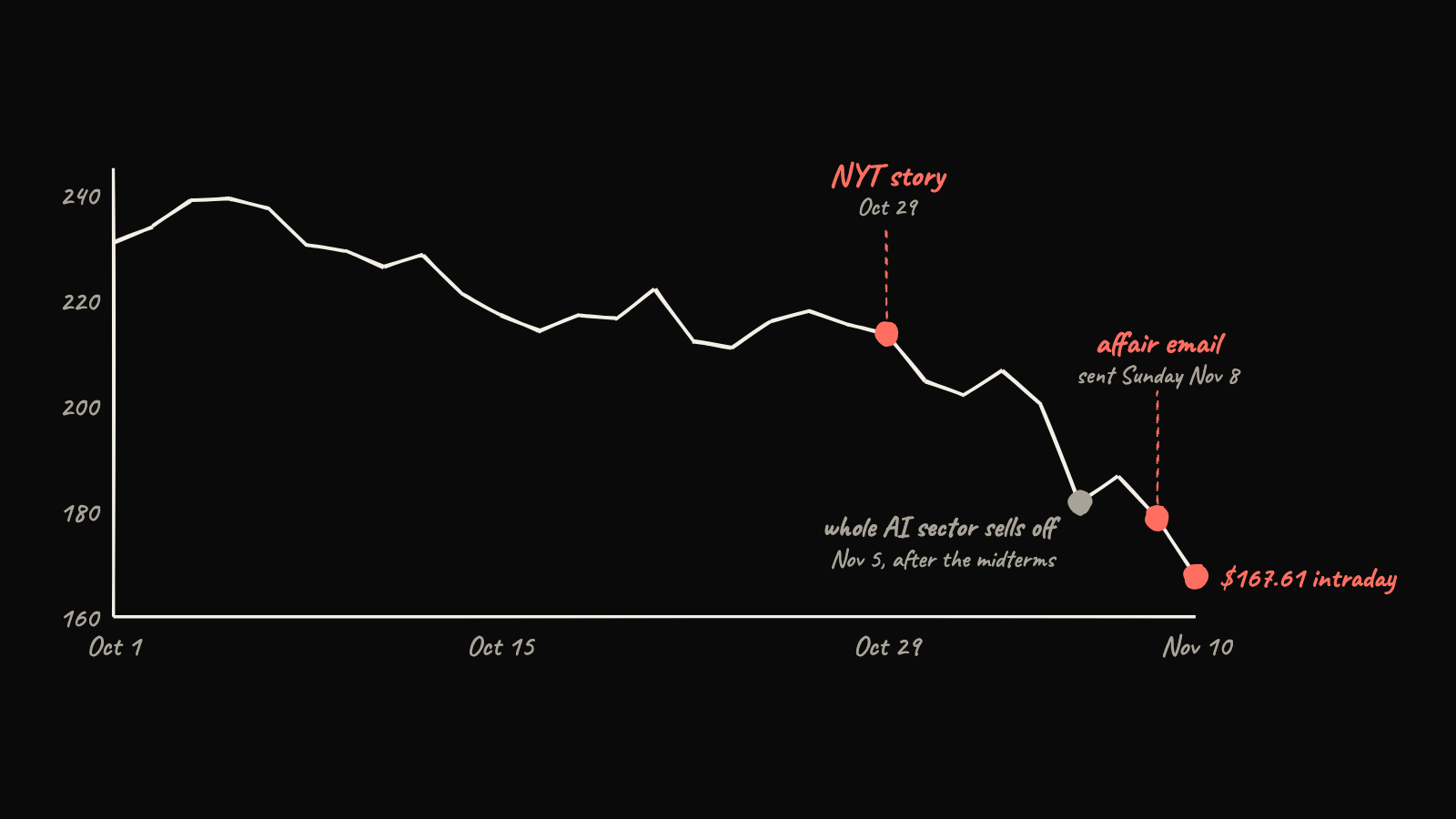
Not all of that is the scandal, though. The biggest single drop, 9.3% on 5 November, hit Micron, AMD and Broadcom too, and came from an AI-sector selloff after the US midterms. The days you can actually pin on this story are 30 October (down 4.2% after the NYT piece), 9 November (down 4.3% after the email) and today (down about 6.2% so far, after the phone call story). Add those up and you get about $28 a share, or something like $680 billion in market value. That is still enormous, but it's about 60% of the headline number.
what holds up and what doesn't
If you followed this on social media, you probably saw a version with more drama than the reporting supports. I took the 17 claims I kept seeing and checked each one against the reporting. A "verified" means multiple reliable outlets or a primary document agree.
| the claim | what the reporting says | verdict |
|---|---|---|
| 7Road started using Nvidia GPUs in 2008 | 7Road was founded in 2008. Nothing ties it to Nvidia that year | unverified |
| Alice was executive director at the firm that invested in 7Road | Reported senior role at Shanghai Hexi, which had 7Road ties | mostly right |
| Nvidia made two watered-down export chips in 2022 | A800 and H800, though the H800 had full H100 compute | right |
| 2023 blanket ban | A threshold rewrite, and the H20 was built to sit just under it | overstated |
| Megaspeed went Singaporean in November, Nvidia partner 4 days later | Ownership change in Nov 2023 is real. The 4 days has no source | half |
| Alice was managing director of Megaspeed | Yes, from March 2023 | right |
| An Indonesian sister company, Speedmatrix, bought $4.8B of chips | The amount is right, but Speedmatrix is Malaysian | wrong country |
| Commerce raided the Indonesian data centre and found GPUs in crates | No reported raid. Sen. Tom Cotton's office mentioned chips "still in boxes" at a Malaysian site | not supported |
| US intelligence found the relationship | NYT, FT, and Jensen's own email | right |
| May 2025 viral video in Taipei | Computex dinner, 22 May 2025 | right |
| August 2025, Singapore wouldn't let Alice leave | "Late summer 2025" per Bloomberg | right-ish |
| Nvidia's counsel called the Commerce under secretary | Teter called Kessler, confirmed by Nvidia | right |
| Field agents escalated, case went to DOJ | DOJ handoff reported, but the escalation story is single-source | plausible |
| NYT investigation in October | 29 October 2026 | right |
| Jensen emailed staff on Diwali | 8 November, which was Diwali | right, by calendar |
| Independent investigation ongoing, China denies | Both true | right |
Out of 17 claims, I'd call 10 right, 3 half-right or overstated, 2 unsupported, 1 wrong on geography and 1 plausible but single-sourced. That is honestly better than most viral finance stories. The errors cluster exactly where a story needs a vivid image, like a raid, crates and a four-day countdown. Those are the bits that make a story feel like a thriller, and those are the bits I couldn't find in any reporting.
what nobody knows yet
As of tonight, nobody has publicly shown what information Alice Huang allegedly passed to Beijing, if any. Nobody has shown that a single Megaspeed chip physically ended up in China, and three separate inspections reportedly found nothing. Nobody has charged Megaspeed, Speedmatrix, Tan Yong Pong or Alice Huang with anything, and the whereabouts of both Alice Huang and Tan Yong Pong are unclear. We also don't know whether Jensen ever knew she was suspected. US officials reportedly believed he didn't, and he has told Trump he had no idea.
What we do know is narrower and, to me, more uncomfortable. The most valuable chip company in the world sold billions of dollars of hardware to a tiny Singapore company with Chinese roots. Its CEO had a personal relationship with that company's former boss. And when Singapore detained her, Nvidia's top lawyer called the official in charge of policing Nvidia's exports. Each of those facts has an innocent explanation on its own, and the hearing on 18 November is going to be about whether they still have one when you put them together.
for the nerds who want the receipts
Everything below is optional.
How TPP is computed. ECCN 3A090 defines total processing performance as
and since one multiply-accumulate is two operations, this is just dense tensor TOPS times the operand width, taking the max over formats. For Nvidia's datacenter parts the FP16 and FP8 numbers give the same answer, so TPP ≈ dense FP16 TFLOPS × 16. Performance density is TPP divided by die area in mm².
The two rules. The October 2022 rule controlled a chip if
and the October 2023 rewrite replaced it with
plus a grey band (3A090.b) for TPP from 2,400 to 4,800 with density from 1.6 to 5.92, or TPP of 1,600 or more with density from 3.2 to 5.92. Chips in that band can ship under a licence exception if you notify first.
| chip | dense FP16 TFLOPS | TPP | link GB/s | die mm² | density | 2022 rule | 2023 rule |
|---|---|---|---|---|---|---|---|
| A100 | 312 | 4,992 | 600 | 826 | 6.04 | blocked | blocked |
| A800 | 312 | 4,992 | 400 | 826 | 6.04 | ships | blocked |
| H100 SXM | 989.5 | 15,832 | 900 | 814 | 19.45 | blocked | blocked |
| H800 | 989.5 | 15,832 | 400 | 814 | 19.45 | ships | blocked |
| H20 | 148 | 2,368 | 900 | 814 | 2.91 | ships | ships |
The H20 lands at 2,368, which is 32 under the 2,400 line, and its density of 2.91 is under 3.2. It was clearly designed against the rule text. The interactive above runs exactly this logic.
tpp = tflops_fp16_dense * 16
pd  = tpp / die_mm2
rule_2022 = blocked if tpp >= 4800 and link >= 600 else ships
rule_2023 = blocked if tpp >= 4800 or (tpp >= 1600 and pd >= 5.92)
            grey    if (2400 <= tpp < 4800 and 1.6 <= pd < 5.92)
                       or (tpp >= 1600 and 3.2 <= pd < 5.92)
            ships   otherwise
The stock numbers. Daily closes from Yahoo Finance. 29 Oct $213.66, 30 Oct $204.64 (−4.22%), 4 Nov $200.13, 5 Nov $181.60 (−9.26%, sector-wide), 6 Nov $186.64, 9 Nov $178.67 (−4.27%), and 10 Nov $167.61 intraday (−6.19%). Scandal days sum to $9.02 + $7.97 + $11.06 = $28.05 per share. At roughly 24.3 billion shares that is about $680 billion, against about $1.1 trillion for the whole 29 October to 10 November move.
How I sourced it. Every timeline entry is tagged verified if two independent outlets or a primary document agree, single-source if it traces back to one outlet's anonymous sources, and disputed if a party on the record contradicts it. I couldn't read the NYT pieces directly, so NYT claims here come through outlets that quote them: CNBC, Axios, CNA, Al Jazeera and The Straits Times. Primary documents I read directly include Jensen's email and the board statement (CNBC), the House chairs' letter, Singapore MHA's statement, Malaysia's trade minister's comments, and the Federal Register rules.
my honest take
I went in expecting a gossip story and came out thinking the gossip is the least interesting part. An affair is a private failure, and Jensen owned it in four sentences. The part that should actually worry people is structural. Export controls are written as thresholds, the most valuable company on earth has a team that reads those thresholds like a contract, and the enforcement side apparently could be slowed down by a single phone call. If Alice Huang turns out to be exactly what US officials think she is, the honey trap only worked because the system around it was already that easy to lean on.
The viral version of this story was right that it's a big deal, and wrong about where the bigness lives. It isn't in a crate in Indonesia. It's in the gap between 4,800 and whatever the next number turns out to be. 🫡